


Koruzna polja sredi mesta
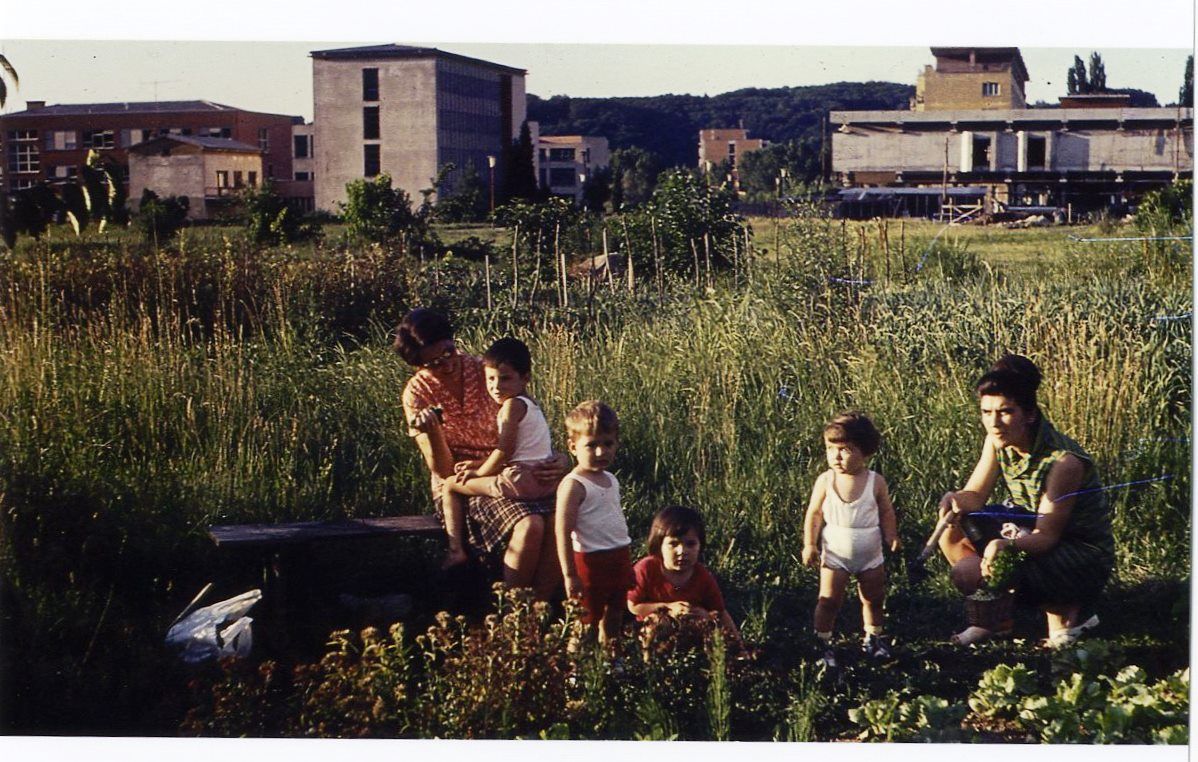

Solkansko polje, njive, vrtovi, sadje na prostoru današnje Nove Gorice
The Solkan field—once made up of farmland, plots, gardens, and orchards—occupied the area of present-day Nova Gorica.
“There were four houses here, and they were demolished. Ours was demolished too. Everywhere there were meadows.” Around former farms, cherries and peaches thrived; in some places there were small vineyards and gardens. Wheat, corn, potatoes, as well as Solkan radicchio and other vegetables grew in the fields (Nusdorfer Vuksanović 2002).
Nova Gorica is geographically located on the Gorizia plain, part of which consists of the Solkan and Šempeter fields. This flatland formed where the Soča River emerges from the mountains and crosses a roughly 10-kilometre-wide belt of Vipava flysch.
When planning the construction of the city, the building committee chose between the Šempeter and Solkan fields. The latter prevailed due to its favourable transport position at the junction of the Soča and Vipava valleys and because of its less fertile soil. Although construction initially began in the southern part (around the Korno stream, Blanča, and Ledine), which was clayey and marshy, the city gradually expanded and “overgrew” fertile fields and farms, of which only a few remained. Fields once stretched from today’s Vojkova Street to the railway station. Around the houses grew cherries and peaches; some had small vineyards and gardens. The fields produced wheat, corn, potatoes, as well as Solkan radicchio and other vegetables (Nusdorfer Vuksanović 2002).
Memories of the first inhabitants are therefore filled with stories of childhood spent outdoors:
“We climbed trees, stole cherries… it was just like in the countryside. Where Cankarjeva Street is today, there was nothing—fields, farmland, meadows… Then they started building apartment blocks and took away our playground. After that, we crawled around construction sites, which were unsecured.”
(b. 1961, interview, October 2022).
Later, with the construction of the main street, expansion of the sewage system, and the building of apartment blocks, most farms were demolished. The municipality built new houses for farmers (e.g. on Prvomajska Street) or bought them apartments. In some cases, families were separated:
“My father cried when they demolished our old house. The municipality built us a new one, but I moved into a block of flats. We were separated—before, we all lived together: four children, grandmother, and parents.”
(Digital collection Kamra).
Houses near today’s church also had livestock. Two stood opposite the petrol station; one still remains. “Further on there were only fields and vineyards—we children knew all of it,” as recorded in collected memories on the Kamra portal. Oxen were used for fieldwork. The Vecchiet farm (Cesta 15. septembra 2), one of the older farms of the Solkan field, still survives today. During the construction of Nova Gorica, its residents provided basic necessities to the first inhabitants of the new town (Nusdorfer Vuksanović 2002). People recall going there to fetch milk.
Among the fields that gradually turned into housing estates (Cankarjeva and Gradnik Brigade), corn flourished. Older residents remember how they transformed cornfields into football pitches:
“We spent most of our childhood outside. We were obsessed with football and played it all the time. There were cornfields here, which were gradually abandoned, and we turned them into a football pitch. No tools, no shovels—just by playing we levelled the ground.”
(Ethnographic workshop with Nova Gorica retirees, November 2024).
Where and when did corn appear in the Gorizia region?
Corn arrived in the Gorizia region from Friuli (Valenčič 1970: 258), where it appeared in the second half of the 16th century. It took time for it to become established and gain people’s trust. By 1602 it was already mentioned in the grain price list of Gradisca, and in 1620 in Udine. At that time, it was somewhat cheaper than sorghum (Valenčič 1970: 258). Its use in Slovenian lands spread in the late 18th and 19th centuries.
Anton Muznik, physician and author of Clima Goritiense (1781), noted that in the Gorizia region “Indian grain, called maize, is cultivated in great quantities” (Muznik 1781/2000: 28). He also wrote that the inhabitants of the valleys mainly ate “polenta, a thick porridge seasoned with salt, butter, or bacon” alongside legumes, vegetables, bread, and wine (ibid.: 70).
Historian Simon Rutar highlighted that in the Gorizia region “the main agricultural yield comes from grain fields. Among all grains, maize is the most widely sown and cultivated… In good years, up to 300,000 hectolitres are produced… It provides the main sustenance for the local population, especially in the Friulian lowlands” (Rutar 1892: 69–70). He also warned of the disease pellagra, which spread from northern Italy after 1884 and particularly affected poorer populations relying mainly on polenta (ibid.).
Avtor: Jasna Fakin Bajec
Vir:
- Gradili smo mesto, spomini zbrani v digitalnem portalu kamra:
• https://www.kamra.si/digitalne-zbirke/dorica-skrt/
• https://www.kamra.si/mm-elementi/kmetija/ - Jasna Fakin Bajec (2020): »Če kruhek pade ti na tla, poberi in poljubi ga! O dediščini pekarstva v Zgornji Vipavski dolini." Izvestje, 17. Pridobljeno od https://ojs.zrc-sazu.si/izvestje/article/view/9404
- Vlado Valenčič (1970): "Kulturne rastline." V: Gospodarska in družbena zgodovina Slovencev. Ljubljana: Državna založba Slovenije, str. 251–272.
- Muznik, Anton (1781/2000 ponatis): Clima Goritiense/Goriška klima. Inštitut za zgodovino medicine Medicinske fakultete, Znanstveno društvo za zgodovino zdravstvene kulture Slovenije, Ljubljana.
- Rutar, Simon (1892): Poknežena grofija Goriška in Gradiščanska. Slovenska matica, Ljubljana.