


Where did the builders of Nova Gorica live?
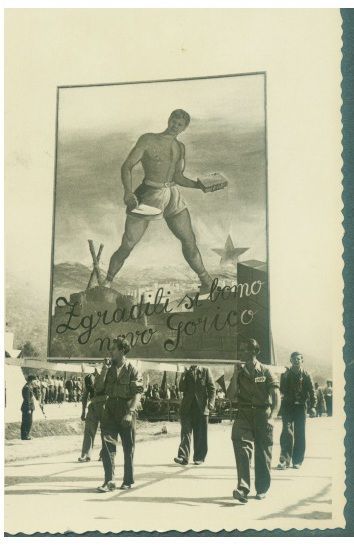
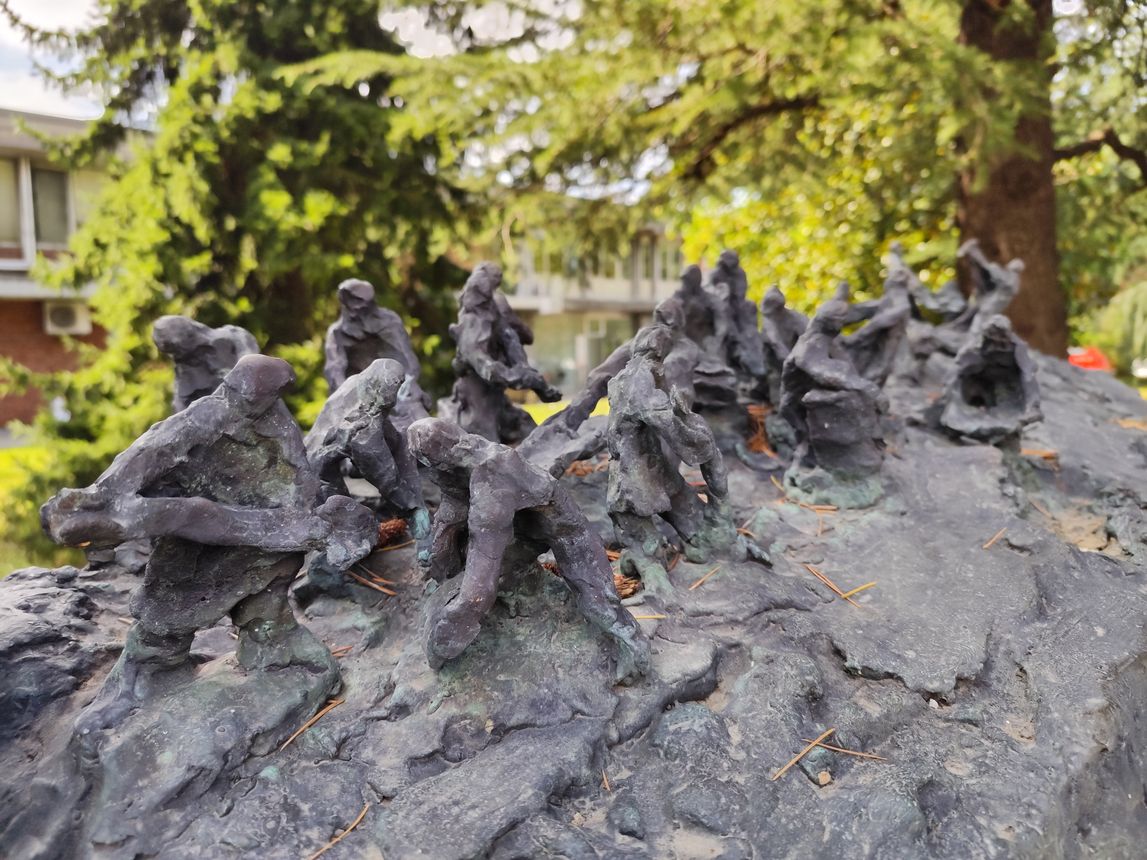
Where did the workers on the construction site sleep? Where did they come from? How did they live, learn, and spend their free time?
The workers who built Nova Gorica came from various companies. On 7 June 1948, the main construction works were awarded to SGP Primorje, which became responsible for building all structures in Nova Gorica (Ukmar 1993: 32). At the beginning of 1948, construction began on a workers’ settlement at Mali klanec (today’s Ronket, later the site of the Ideal textile factory). Initially, they built an access road and six barracks used as improvised housing, a canteen, and an office. In the old brickworks, bathrooms with showers were arranged. These improvised barracks served the workers only until permanent housing and other facilities were built. By May 1948, an infirmary, offices, workshops, and storage facilities had been constructed, and preparations for new housing blocks were underway (Ukmar 1993: 32).
“Where there are now terraced houses, beyond the retirement home, there were initially barracks. They were called ‘new Sarajevo’. They were built for the needs of constructing Nova Gorica and for the workers.”
(Source: https://www.kamra.si/digitalne-zbirke/ana-in-erik-katnik-copy/)
At first, the workers did not display the same competitive spirit as the youth labour brigades. As historian Dragica Ukmar notes for the year 1947:
“There was no competition among workers at all. Therefore, a decision was adopted to introduce competition for all types of work, from individual groups onwards, and to implement the brigade system across all sectors, along with comprehensive rationalisation of labour.”
(Archives of the Republic of Slovenia, Minutes of the production meeting at the Nova Gorica construction site, 22 November 1948, cf. Ukmar 1993: 26).
Workers thus began to operate within a brigade system, competing with one another, exceeding annual plans, and earning the title of shock workers.
SGP Primorje also competed with other companies involved in the construction of Nova Gorica, including the Republican Construction Company for Roads, the Rdeča zvezda Lime Plant in Solkan, the Anhovo Cement Plant, and brickworks in Renče, Bukovica, and Bilje (Ukmar 1993: 32).
Within their workers’ settlement, they also organised a workers’ economy. This meant that the workers engaged in farming themselves, maintained livestock, and operated their own shops. In Nova Gorica, they cultivated 20 hectares of land with potatoes, vegetables, and other crops. Surpluses were even supplied to construction sites in Ajdovščina and Idrija. They also had their own construction site administration and trade union branches (ibid.).
The settlement included a school for masonry apprentices, a foremen’s school, a construction school, and a hall for cultural events. In 1949, the construction school was attended by 250 students from the companies Primorje and Ograd. There was also a “Red Corner” equipped with a radio, daily newspapers, and a library containing 800 contemporary books. Various courses were occasionally organised (ibid.: 33).
A special group on the construction site were women. Through voluntary work on the construction of Nova Gorica, they were preparing for their elections (elections to the AFŽ committee). They aimed to complete as many voluntary working hours as possible. Not all workers lived in the settlement—some returned home in the evenings and came back to work in the morning.
Part of the workers’ settlement was converted into school facilities in 1951, while another part remained in use for workers.
Avtor: Jasna Fakin Bajec
Vir:
- Bastančič, Mira. 2017. Delavci na poti med topolo, Zgradili smo mesto
- Ukmar, Danica. 1993. Začetki gradnje Nove Gorice, Kronika: časopis za slovensko krajevno zgodovino (1993), letnik 41, številka 2. URN:NBN:SI:doc-T6USNG8G from http://www.dlib.si, str. 1837.