


The First Kindergarten in the Town
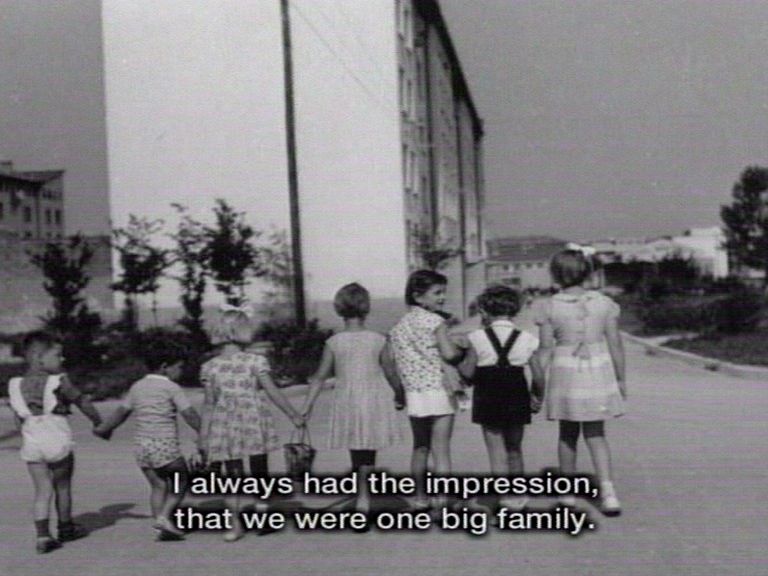

Memories of residents of the first kindergarten in the Russian Blocks
One of the major problems in the first years of the formation of Nova Gorica was childcare. The first kindergarten was organised in an apartment in Russian Block No. 11 (today Kidričeva Street 29). How do the locals remember it?
“That spoon of fish oil, which was just an ordinary spoon, was like a shovel. I couldn’t swallow it…”
(Ethnographic workshop, July 2023)
The first inhabitants who began settling Nova Gorica were young. In the new developing town they were looking for opportunities for employment, progress, and development. They found jobs in new administrative departments (cadastre, court, archive, inspectorate), at the municipality, in educational institutions (schools), and in the first factories (Meblo, Ideal, SGP). They started families, and the arrival of children naturally caused concerns for many young parents.
Many families did not have grandparents nearby, and in the 1950s and 1960s maternity leave lasted only three months. Therefore, many mothers had to find nannies for their babies or even leave the child with grandmothers in the countryside and visit them only on weekends. Nannies and domestic helpers came from nearby and more distant places, even from other republics of Yugoslavia (e.g. Varaždin). They were organised in a special association based in Frnaža, which also had a president who ensured that families did not exploit them too much.
A former domestic helper from the area of Varaždin recalled:
“I worked for a family here in Nova Gorica. At that time everyone had jobs. He was an engineer at Elektro Gorica, and the lady worked at the bank. They were good people. I have no complaints about them. And I cleaned, tidied, and took care of the child. The ladies did not wash by hand, there were no machines yet. How many sheets I had to wash by hand!”
(Ethnographic workshop in the Nova Gorica Retirement Home, November 2022)
A teacher who came to Nova Gorica from Vipavski Križ left her small child with her mother:
“I taught here in Nova Gorica mostly. First in Pristava for two years. And then from exhaustion, because I taught all day, there was full-day teaching, morning and afternoon, I had to give away my little daughter, and I got sick with lung disease. I was on sick leave for a year.”
(Ethnographic workshop, November 2022)
The biggest problem in the town was childcare:
“I went through all the apartments in the Russian Blocks because I was looking for childcare for my daughter. But I didn’t find any. And then, because I didn’t find anything, I had to hire a domestic helper. But again, half [the money] went to her, half to me. It was hard to live like that. All the grandmothers stayed in the hills. Mothers and fathers were employed. At that time you couldn’t get childcare. Because children were accepted into kindergarten only at the age of three. And maternity leave lasted 105 days. I had a domestic helper for two and a half years, and then she went to kindergarten.”
(Ethnographic workshop, November 2022)
The first kindergarten for older children was initially organised in Russian Block No. 11 (Kidričeva 29). For this purpose, a ground-floor three-room apartment was adapted, with a kitchen, bathroom, toilet, and two rooms (one larger and one smaller). About 30 children were cared for by two educators.
Memories of former children, now elderly residents, are positive. One interlocutor who lived in the same block said:
“I went to that kindergarten and I was the main one, because I only had one flight of stairs to get there. The teachers had to invent various things. There was also housekeeping, we were supposed to bake bread. And we made something like biscuits. And I brought that thing upstairs to my mother so she baked it. And now imagine how happy and proud I was when I brought that bread down.”
(Ethnographic workshop, July 2023)
Children received snacks prepared by the educators. What remained most in memory were yellow cheese, powdered milk, and fish oil, which they received as part of American aid:
“When we came in the morning, first there was powdered milk. A piece of that yellow cheese, so-called Marshall aid. And fish oil, which ended up in the flower pot.”
The oil protected children from rickets, but not from the unpleasant taste:
“And mostly I remember only one thing. It’s hard to put yourself in the position of a small child. A small child is not only mentally at that level, but also physically small. And what’s the problem? That spoon of fish oil, which was just an ordinary spoon, was like a shovel. I couldn’t swallow it.”
Between 1960 and 1962, the kindergarten was moved to another Russian Block (Kidričeva 34), where its administration still remains today. Later, a larger kindergarten was opened.
Avtor: Jasna Fakin Bajec
Vir:
Workshop at the Nova Gorica Retirement Home, November 2022

Tags
Povezani članki
Russian Blocks - the First Apartments in Town