


Youth Work Brigades – their significance for Yugoslavia
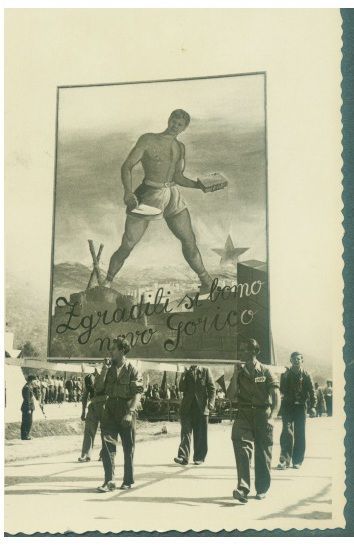
Who were the youth work brigades? Why were they important for building the Yugoslav identity of brotherhood and unity? What does “shock work” (udarniško delo) mean? Why did they foster a competitive spirit?
The construction of Nova Gorica began with great enthusiasm after a difficult and uncertain period that marked the Primorska region due to struggles over political borders and state affiliation. During this time, youth and later front work brigades also played an important role, as they began building the new Yugoslav city.
Who were the youth brigades?
“They were groups of individuals formally connected within a shared work process. In Yugoslavia, already during the war, they adopted the structure of military units and were organized as squads, companies, battalions, and brigades. /…/ Their tasks ranged from participation in primary sectors of the economy, infrastructure construction, and agricultural work to activities in education, training, and assistance to socially vulnerable groups.” (Stibilj 2017: 53)
Youth brigades were composed of young people over the age of 16 who, as a social group, became the main support of the authorities in the post-war recovery and development of war-devastated Yugoslavia. Central to this was shock work (udarniško delo), which meant:
“The competitive performance of primarily physical labour in the early phase of the development of a socialist society. It was voluntary, but organized and encouraged through strong propaganda. Its main goal was to increase labour productivity and reduce production costs. In Slovenia after 1945, shock labour competition transformed into voluntary mass labour, which is why it is also referred to as shock work.” (Encyclopaedia of Slovenia, cf. Stibilj 2017: 55)
Competitions were a characteristic form of youth work; they competed in various fields—from rebuilding roads, constructing towns, collecting herbs, to cultural and educational activities and other forms of engagement. Competition was understood as a new way of life and work for the socialist individual.
“From the very beginning, we were confronted at the worksite with the competitive spirit that constantly prevailed among the brigadiers. One of the female brigadiers, usually the one physically weaker, carefully inspected every wheelbarrow brought to the embankment and, if it was properly loaded, marked it with a line for the corresponding trio. Every day after work, with the participation of the foreman, they summed up the excavated and transported quantities of earth and immediately passed the results to the brigade commander, who, after processing them, forwarded them to the headquarters of the work action.”
(Source: https://www.kamra.si/digitalne-zbirke/oskar-jogan/)
During the first Five-Year Plan (until 1952), the goals of the youth work brigades were primarily economic: reconstruction and construction of industrial, transport, communal, and other infrastructure. The purpose of the work actions was also to bring together young people of different nationalities and to strengthen Yugoslav identity in the spirit of brotherhood and unity. The actions also had strong educational, cultural, sporting, and formative functions. They emphasized comradeship and solidarity and directly promoted socialist ideology. Many young people, especially from underdeveloped areas, gained education and practical skills (such as operating machinery), learned to write, and for many it was their first encounter with film and theatre (Prinčič and Repe 1997: 153).
In Slovenia, the majority of work actions took place between 1945 and 1947 and represented voluntary reconstruction work, involving not only youth but also the wider population. They built cooperative centres, repaired roads, cleared rubble, and regulated streams (e.g. the Lijak stream). Until 1947, youth work brigades in today’s Primorska region operated under the authority of the Union of Anti-Fascist Youth of the Julian March, closely linked with the Communist Youth League of the same region (Stibilj 2017: 55). In 1946, federal and republic-level work actions also began, which were far larger and better organized than smaller local efforts. Among the most important federal projects in Yugoslavia were the construction of the Brčko–Banovići railway (1946) and Šamac–Sarajevo (1947), in which youth from Primorska also participated. The construction of Nova Gorica was considered the third such federal action.
The work of the brigades followed a structured schedule. In addition to physical labour, considerable emphasis was placed on education and cultural activities. All activities were carried out collectively, with units typically joining work actions for two months. The organizers were regional and municipal branches of the Socialist Youth League of Slovenia (ZSMS), responsible for preparation as well as for the moral, political, and material oversight of the brigades. Young people were attracted in various ways: through rich cultural and sports programmes, opportunities to gain skills, and for factory workers, participation counted as working hours. After returning from major work actions, brigadiers had advantages in university admissions, access to student housing, and employment (Stibilj 2017: 55).
Opponents of the party system sharply criticized youth labour and shock work, arguing that:
“Shock work was merely a new form of exploitation of the people; they pointed to poor conditions at large youth work actions in Yugoslavia. /…/ They described them as forced labour that had become a system of public works, and participation in these actions as a result of institutional coercion by a totalitarian regime.” (Stibilj 2017: 57)
By the late 1960s, as Slovenia modernized and opened toward the West, the actions lost their economic significance. They were revived in the 1970s, primarily with political rather than economic aims. In remote areas (e.g. Brkini), they continued to repair roads, schools, and other necessary infrastructure (Filipčič 2016). In the first half of the 1980s, youth work brigades became increasingly limited to specialized units and by the end of the decade they had completely faded away (Prinčič and Repe 1997: 154).
Avtor: Jasna Fakin Bajec
Vir:
Rok Filipčič (2016): "Brigadirski ho-ruk!: prva štiri leta mladinskih delovnih akcij v Brkinih 1975–1978," Prispevki za novejšo zgodovino LV /2, str. 22-39,
file:///C:/Users/Jasna/Downloads/admin,+Journal+manager,+PNZ-2016-2-Filipcic-Brigadirski_ho-ruk%20(1).pdf (25. 10. 2024).
Luljana Burcar (2019): "Mladinske delovne akcije in železniške proge prve petletke: literarni zapisi in pomniki o izgradnji novega prostora in čas", Ars & Humanitas, 13(2), str. 184-202. https://doi.org/10.4312/ars.13.2.184-202; file:///C:/Users/Jasna/Downloads/filipzule,+%7B$userGroup%7D,+Lilijana+Burcar.pdf (ogled 13. 12. 2024).
Nova Gorica: Zgradili smo mesto, zapisi na portalu Kamra, https://www.kamra.si/digitalne-zbirke (ogled: 10. 10. 2024)
Jože Prinčič in Božo Repe (1997): »Mi gradimo progo, proga gradi nas«. V: Kronika XX. Stoletja. Drnovšek M. idr. (ur.), str. 153-154.
Matjaž Stibilj (2017): »Vsa mladina v delovne brigade!«. Mladinske delovne brigade Julijske krajine do začetka gradnje Nove Gorice. V: Marušič, Branko (ur.), Narodu Gorico novo bomo dali v dar: Ob sedemdesetiletnici Nove Gorice. Nova Gorica: Območno združenje Zveze borcev za vrednote narodnoosvobodilnega boja, str. 53 – 60.
Gašper Šmid in Žerko Štrumbl (2019) 70 let železniške proge Brčko–Banovići, Arhiv Republike Slovenije. Vir: https://www.gov.si/novice/2019-06-01-70-let-zelezniske-proge-brckobanovici (ogled: 13. 12. 2014).