


Youth Work Brigades in Nova Gorica – detailed overview
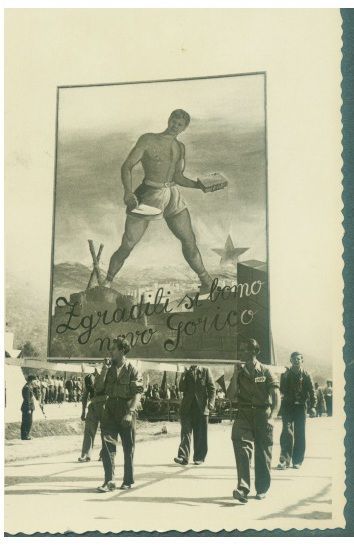
The initial preparatory works for the construction of Nova Gorica revealed challenges in mobilizing a sufficient number of workers. For this reason, large-scale federal voluntary work actions were organized. Youth work brigades from across Yugoslavia arrived in Nova Gorica.
“Our Primorska calls us, the land of vines and stone, Nanos calls from afar, the blue wave of the Soča. We go determined and steadfast, with a strong flame in our hearts; we will give the nation a new Gorizia as a gift.”
Song of the builders of Nova Gorica, Ivan Minatti
After the political decision to build a new town next to Gorizia—which remained in Italy—later named Nova Gorica, the first spatial planning actions began on the plain between the railway line, Panovec, and Solkan, with the town centre on Blanče and Ledine. Young people from all over Yugoslavia took up shovels, wooden wheelbarrows, pickaxes, and other tools. The preparation of the site for the construction of the new town was included in a federal youth work action, meaning it was one of the most important state reconstruction projects.
“Following the already established nationwide model used in the construction of the Brčko–Banovići and Šamac–Sarajevo railways and other major projects, this task [the construction of Nova Gorica – author’s note] was entrusted to youth work brigades.”
Participants in youth work actions were generally not allowed to be younger than 16. Veterans and members of the Yugoslav People’s Army (JLA) could also participate. Brigadiers had to bring personal clothing, hygiene supplies, work footwear, shorts and a shirt, clothing for bad weather, and headgear (Filipčič 2016: 26). Regulations also stipulated that actions were organized in at least three shifts, each lasting at least 21 days, with a minimum of two brigades per shift and at least 40 brigadiers per brigade.
What was the situation in Nova Gorica?
The construction of Nova Gorica as a federal youth work action began on 3 December 1947, when brigadiers—who had previously worked on regulating the Lijak stream—started preparatory works. They formed the core of three youth brigades of the first shift, which counted 654 brigadiers. The first shift lasted until 30 January 1948 and included brigades from Serbia and Croatia (Ukmar 2017).
The second shift, which began on 9 February 1948 and lasted until 12 April 1948, consisted of three brigades of Primorska youth—named after Oton Župančič, Jože Srebrnič, and Ivan Cankar. An additional special brigade also arrived, providing both theoretical and practical training for future brigade leaders, cultural workers, sports instructors (football), and statisticians (Ukmar 2017: 128).
The third shift, from 12 April to mid-June 1948, included brigades from Slavonski Brod (Croatia), Bosnia and Herzegovina, and Slovenia.
In mid-June, the fourth shift arrived, notable for involving five brigades composed largely of young people who had remedial school exams after the academic year. Educational courses were organized for them, and teachers also joined the work actions to assist students. This was the largest shift, with as many as 17 brigades, consisting mainly of students, secondary school pupils, and apprentices from across Yugoslavia (Mervič 2017: 142). At political lectures, participants also protested against the Cominform and demonstrated their trust in the Party through competition and increased labour efforts. The competitive spirit was fundamental: brigades competed not only in physical labour but also in educational, sporting, and political-educational activities.
Altogether, from December 1947 to mid-November 1948, 25 youth work brigades with 5,194 brigadiers participated in the construction of Nova Gorica. After their departure—when young people returned to schools and universities—the work was continued by front brigades.
The main work sites of the youth brigades in the area of future Nova Gorica included:
• regulation and deepening of the Koren stream and its surroundings,
• excavation and construction of the main road (the Magistrala),
• construction of the bypass road Solkan–Šempeter via Rafut to Rožna Dolina,
• construction of the foundations for the municipal building,
• construction of the foundations of the road bridge over the Koren,
• construction of the foundations of the Meblo factory,
• preparation of construction sites for residential blocks, later known as the “Russian blocks,” on both sides of the southern part of the Magistrala.
Avtor: Jasna Fakin Bajec
Vir:
Sources:
- Filipčič, Rok. 2018. Brigadirski ho-ruk!: prva štiri leta mladinskih delovnih akcij v Brkinih 1975–1978, Prispevki za novejšo zgodovino LVI - 2/2016, str. 22-39.
- Ivanc, Jože. 2008. Spomini na začetke gradnje Nove Gorice: Govor ob odkritju spomenika graditeljem Nove Gorice, 6. septembra 2008. V: Oton Mozetič, mag. Darinka Kozinc, Melanija Kerševan (ur.), V spomin in zahvalo graditeljem Nove Gorice ob 60-letnici začetka gradnje. Nova Gorica: Krajevna skupnost Nova Gorica.
- Mervič Igor, Franc. 2017. Zgradili naj bi nekaj, kar bi sijalo preko meje. V: V: Marušič, Branko (ur.), Narodu Gorico novo bomo dali v dar: Ob sedemdesetletnici Nove Gorice. Nova Gorica: Območno združenje Zveze borcev za vrednote narodnoosvobodilnega boja, str. 142–144.
- Ukmar Danica, 2017. Začetki gradnje Nove Gorice. V: Marušič, Branko (ur.), Narodu Gorico novo bomo dali v dar: Ob sedemdesetiletnici Nove Gorice. Nova Gorica: Območno združenje Zveze borcev za vrednote narodnoosvobodilnega boja, str. 126-132.