


Paris Peace Treaty
Post-war agreement on the border between Italy and Yugoslavia
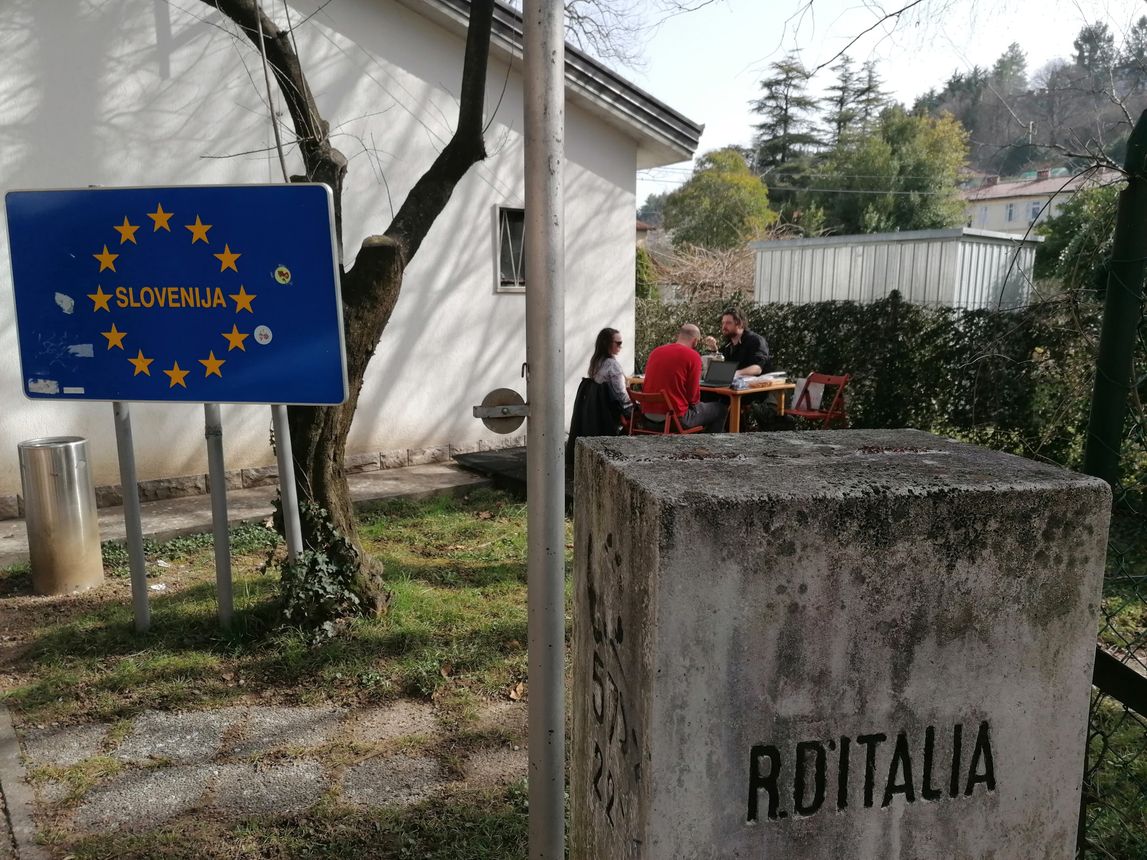
The Paris Peace Treaty established the new border between Italy and the then Yugoslavia (today Slovenia). It divided the Gorizia region, thereby breaking centuries-old ties between the city and its hinterland.
At the end of World War II, units of the IV Yugoslav Army and the IX Corps liberated the entire Littoral and Istria, including Trieste, Gorizia, and Cividale. This was not in the interest of the Allied powers, whose strategic goal was to restore the territory of the Julian March up to the Rapallo border (1920). Under the threat of military intervention, the Allies demanded the withdrawal of Yugoslav forces from Trieste and Gorizia.
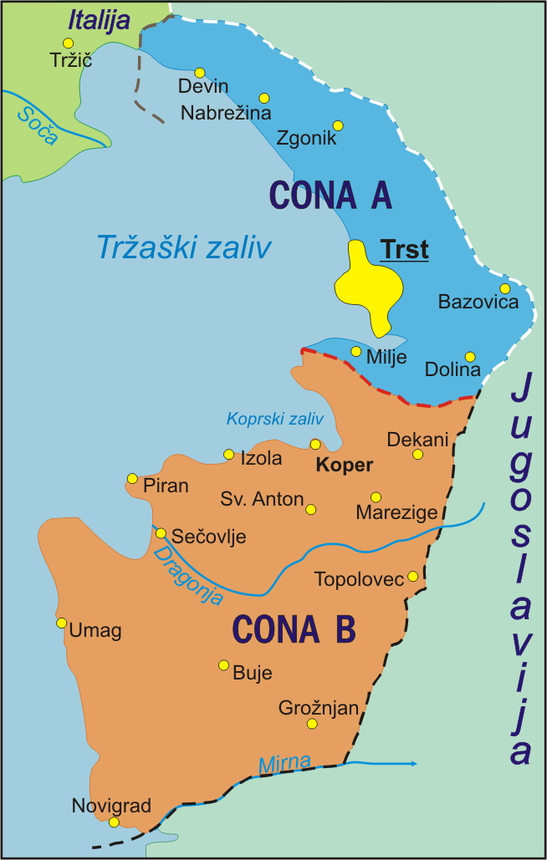
Following the proposal of British General Frederick Edgworth Morgan, the territory was divided into two zones. Zone A, under Anglo-American administration, included Pula, Trieste with its surroundings, and the territory west of the Trieste–Gorizia–Most na Soči railway line. Zone B, extending to the Rapallo border, was administered by the Yugoslav army. The agreement was formalised on 9 June 1945 with the Belgrade Agreement, after which Yugoslav troops withdrew from Trieste (12 June) and Gorizia (16 June).
Between January and April 1946, negotiations of the Council of Foreign Ministers took place in London, leading to the decision to convene a peace conference with the participation of 21 Allied countries. Due to conflicting proposals regarding the border, an expert commission was established.
The commission arrived in Trieste on 7 March 1946. Its task was to determine the border based on “ethnic, geographical and economic facts, and not propaganda. The commission should not be influenced by propaganda tricks, threats, accusations, military displays, flags or symbolic decorations.”
Despite this, both Yugoslav and Italian national symbols were widely displayed. Villages expressed their allegiance by raising flags, writing slogans such as “This is Yugoslavia,” “Our Tito,” “This is Slovenia,” and erecting ceremonial arches.
At the Paris meeting of the Council of Foreign Ministers (April–May 1946), no proposal satisfied both sides. Yugoslavia supported the Soviet proposal, advocating the inclusion of all Slovene ethnic territory, while Italy supported the American “Wilson Line.” The final decision, adopted on 2 July 1946, followed a French compromise.
This compromise divided the Gorizia region: the city of Gorizia and its more urban hinterland remained in Italy, while the larger, more rural part was assigned to Yugoslavia. Although Yugoslavia received 92% of the territory, 74% of the population remained in Italy. The new border, initially closed, severed historical and economic connections.
The Paris Peace Conference began on 29 August 1946, and the new border was approved in October. The treaty was signed on 10 February 1947 and came into force on 15 September 1947.
As a consequence of losing Gorizia, Yugoslav authorities decided to build a new town—Nova Gorica.
Although Yugoslavia lost Gorizia, it gained significant territory, today forming nearly a quarter of Slovenia. For this reason, 15 September is commemorated in Slovenia as the Day of the Return of Primorska to the Homeland.
Avtor: Jasna Fakin Bajec
Vir:
Šušmelj, Jože. 2017. Pred 70 leti je bila podpisana Pariška mirovna pogodba. https://www.svobodnabeseda.si/pred-70-leti-je-bila-podpisana-pariska-mirovna-pogodba/ [ogled: 10. 10. 2024].
Troha, Nevenka. 1997. Mirovna pogodba z Italijo. V: Drnovšek M. idr. (ur.). Slovenska kronika XX stoletja, str. 149.
Pirjevec, Jože. 1998. Pariška mirovna konferenca. Acta Histriae, letnik 6, številka 6, str. 7-14. URN:NBN:SI:DOC-FDF0O3S2 from http://www.dlib.si
Šušmelj Jože, 2017. Pred sedemdeseti leti je bila podpisana Pariška mirovna pogodba. V: Marušič, Branko (ur.), Narodu Gorico novo bomo dali v dar: Ob sedemdesetletnici Nove Gorice. Nova Gorica: Območno združenje Zveze borcev za vrednote narodnoosvobodilnega boja, str. 18-26.
Šušmelj, Jože. 1997. Odpiranje meje: Sodelovanje med Novo Gorico in Gorico. V: Jan, Zoltan (ur.). Nova Gorica-Gorica: izzivi in možnosti sobivanja: zbornik. Nova Gorica: Mestna občina, str. 9-28.